
The times of SEO was like stuffing keywords and hoping google will recognise it and put it on page one for visibility. Well, this technique is fading fast making way for the era of GEO-Generative Engine Optimisation, where AI is rewriting the entire rule book set by SEO.
The SEO Era
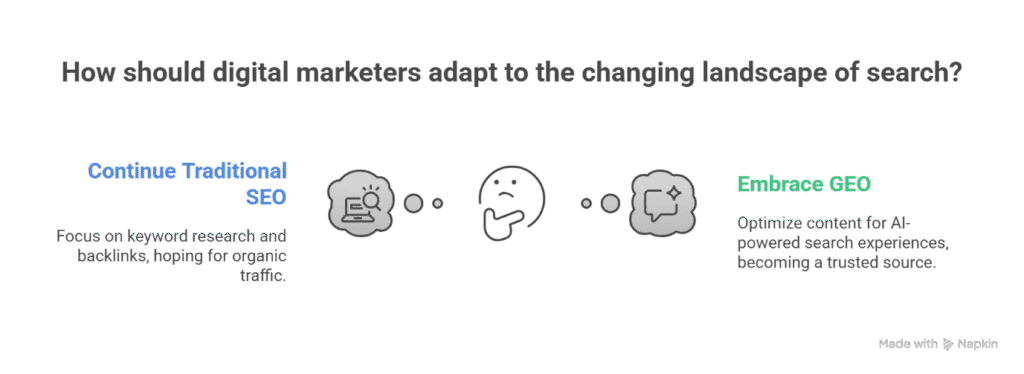
For over more than a decade SEO has been the best companion of every digital marketer, where we have pursued search engines with well thought descriptions, strategic keyword placement and quality backlinks. It was something every digital marketer and content developer understood about what Google wanted and gave exactly that.
But it is showing its age now- old predictable formula of research the keywords, create content around those keywords, add links, and just hope the organic traffic kicks in. Well, this method did works for decades, but now it’s becoming very mechanical, predictable, almost robotic. Not to forget to mention it was the actual robots (AI) that showed us what we were missing!
The traditional SEO approach optimized for search engine results pages (SERPs), where users would click through to websites for information. But what happens when the search engine starts providing comprehensive answers directly, without requiring that crucial click-through? Suddenly, being the best result on page one isn’t enough—you need to be the source that AI systems trust and cite.
Enter GEO
Generative Engine Optimization isn’t here to replace SEO entirely. GEO focuses on optimizing content for AI-powered search experiences, where generative AI models create responses by synthesizing information from multiple sources.
When someone asks ChatGPT, Claude, or Bard a question, these systems don’t just serve up a list of links. The responses generated is more conversational and comprehensive and this they learn from their training data and from real time web searches. So, the question now is what is your job as a marketer? Well, just make sure your content becomes the source of their reference and that will be what they recommend.
Now this change shows the shift in the user behaviour. From googling and clicking on multiple results it is now shifting to asking AI assistants directly and expecting complete answers. What we want today is conversations and not search results. We want solutions and not links to ‘potential’ solutions.
The GEO Playbook: New Rules for a New Game
1. Authority Over Keywords
Even today keywords matter, but establishing a topical authority is very important for GEO success. AI systems prefer sources that show a well comprehensive expertise across related topics. So now we don’t just target individual keywords but focus on interpretation of relationship among the topics.
All that matters is your content should be the go-to source in your particular field. So, content should be created accordingly which is in-depth, well researched and that covers the topic thoroughly. AI systems easily identify shallow content and they prefer not to go for it.
2. Conversational Content Architecture
GEO has one demand and that is natural language pattern. It’s simple, write the content like you’re answering your friend’s question and not like a typical corporate presentation. AI recognises it easily and so the content should be like how we communicate normally in real.
Structure your content to anticipate follow-up questions. If you’re explaining a concept, address the “but what about…” scenarios that naturally arise. This conversational threading helps AI systems understand the full scope of your expertise.
3. Source Credibility and Citation
Being quotable is everything in the GEO world. AI evaluates source credibility, content that cites reputable sources and demonstrates factual accuracy. Partner with Varenyam Marketing Solutions and become the source that other authoritative sites cite. This ultimately creates a virtuous cycle where AI systems recognise your content as trustworthy based on patterns across the web.
4. Real-Time Relevance
GEO rewards freshness and relevance. Unlike traditional SEO, where content could maintain rankings for months or years. AI systems prioritise recent information especially for matters where recent and updated information matters.
At Varenyam Marketing Solutions our team focuses on developing a content strategy that includes regular updates to evergreen content and rapid response capabilities for trending topics in your particular industry.
The Technical Side: Making Your Content AI-Friendly
GEO success requires technical optimization that goes beyond traditional SEO metrics. It is important that you make your page loading faster as a slower loading page is usually skipped in favour of the faster one by AI systems, hence even page loading speed matters.
Consider implementing FAQ sections that directly address common questions in your field. AI systems love clear, direct answers to specific questions as it makes their job easier and your content more likely to be featured in AI-generated responses.
The Human Element: Why Authenticity Wins
The more human and authentic your content, the better AI systems tend to respond to it. Artificial intelligence systems are trained on human-generated content, so they inherently understand and value human perspectives, experiences, and insights.
Keep your style and personality in content intact while pursuing for AI optimisation. The brands that will go ahead are the ones that maintain authenticity be it in voices or content. Share case studies, personal insights, experiences, and the unique perspectives that only you as an organisation can provide.
Measuring GEO Success: New Metrics for New Goals
Traditional SEO metrics like keyword rankings and organic traffic remain important, but GEO requires additional measurement approaches. Monitor how often your content appears in AI-generated responses across different platforms. Track mentions and citations in AI outputs, even when they don’t drive direct traffic.
Brand mention analysis becomes crucial; are you being referenced as an authority in AI-generated content? Are your insights being synthesized and shared in ways that build your reputation even without direct attribution?
The Road Ahead: Preparing for an AI-First Future at Varenyam Marketing Solutions
The future is shifting to GEO from SEO but it is not happening overnight, its eventually happening quickly. It is those smart marketers who are adapting to it and balancing both simultaneously. Well, the good news is that many GEO best practices actually improve SEO performance as well. So, start now by checking your existing content through a GEO lens. Whether it is a reliable source for AI systems to recognise? Does it demonstrate clear expertise? Is it structured in a way AI can easily understand and synthesise?
The best thing is you need not worry about any of it, all you need is to partner with us at marketingbyvms.com/
We believe the brands that thrive in this new landscape will be those that view AI not as a threat to their search visibility, but as a sophisticated intermediary that can amplify their expertise to audiences who value AI-curated information.
As we stand at this inflection point between the SEO era and the GEO future, one thing is certain: the organizations that adapt quickly and authentically will find themselves not just surviving but thriving in an AI-first digital ecosystem. The question isn’t whether GEO will replace traditional search optimization but it’s whether you’ll be ready when it does?
The future of search is conversational, intelligent, and surprisingly human. Are you ready to join the conversation? Contact Varenyam Marketing Solutions today at https://marketingbyvms.com/